The Ghost Composers of Seoul
An investigative report uncovering the hidden composers behind K-pop’s billion-view hits—and the economic system that keeps them anonymous, underpaid, and contractually silent.

While K-pop labels celebrate record-breaking profits, chart domination, and billion-view milestones, the internal engine of the industry remains largely invisible. Behind the idols, beyond the choreography and branding, sits a workforce rarely named: the composers.
They write the melodies. They build the hooks. They power the machine.
And in many cases, they do so without royalties, without control, and without a voice.
The Invisible Engine of Global Pop
K-pop’s global success is often framed as a triumph of performance, fandom, and flawless branding. But the sound itself — the part that actually travels across borders — is frequently created by freelance or semi-anonymous composers, many of whom never appear on stage, in documentaries, or on award platforms.
Songwriting camps in Seoul and abroad funnel hundreds of demos into label pipelines every year. Only a small fraction are selected. Fewer still provide long-term income.
For many creators, the outcome is a paradox: a global hit song, paired with personal financial instability.
The Pay Gap
A single successful K-pop track can generate millions of dollars through streaming, licensing, advertising, and global distribution. Yet the composer behind that song may receive only a one-time flat fee — sometimes equivalent to a few months’ rent in Seoul.
Many composers live in goshiwons: ultra-small single rooms often under 7 m², originally intended for students, now increasingly used by creative freelancers priced out of the city.
This gap is structural, not anecdotal.
Streaming Revenue Split (South Korea – Approximate)
You can see the imbalance clearly in how streaming revenue is distributed:
Infographic: South Korea – Streaming Revenue Split
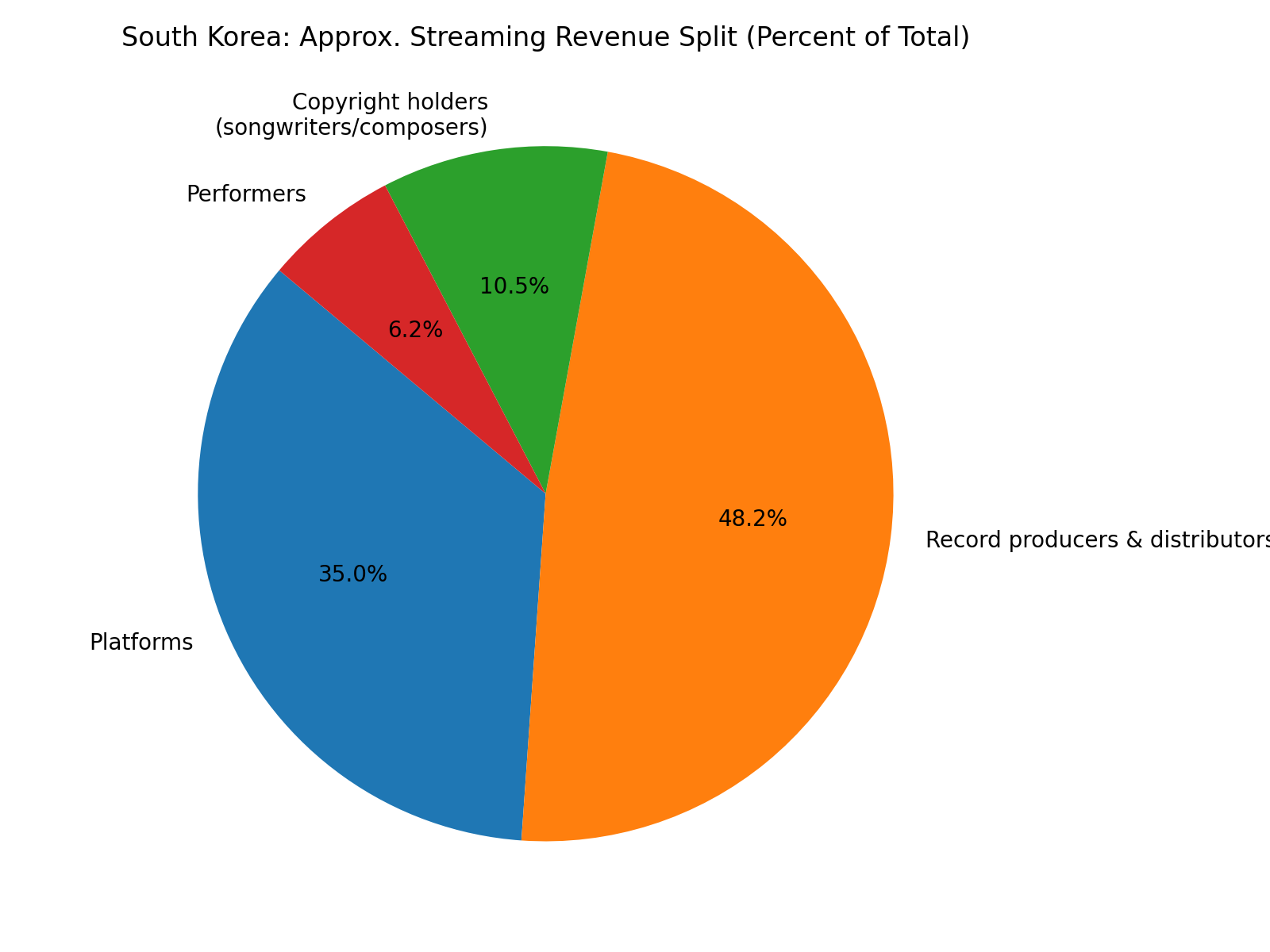
- Platforms: ~35%
- Record producers & distributors: ~48.25%
- Copyright holders (songwriters & composers): ~10.5%
- Performers: ~6.25%
In other words, less than one-ninth of total streaming revenue reaches the people who wrote the music.
Not Just Korea: A Comparative View
The situation is especially stark when compared internationally.
Infographic: Copyright-Holder Share by Country (Data Box below)
| Country | Composer / Songwriter Share |
|---|---|
| South Korea | ~10.5% |
| United States | ~12.3% |
| United Kingdom | ~16% |
| Germany | ~15% |
Korea’s creators earn significantly less from the same global platforms — even as K-pop outperforms many Western markets in international reach.
The Contract Clause
Most major entertainment companies rely on rights-transfer clauses embedded deep within songwriting contracts.
These clauses typically mean:
- 95% of royalties retained by labels
- 0% creative control for the original composer
- 100% NDAs signed
In exchange, the composer gets:
- A flat fee
- A credit (sometimes)
- The “honor” of writing for a major group
Once the rights are transferred, the composer no longer benefits from the song’s success — even if it goes viral, wins awards, or becomes a defining track of the decade.
The machine runs best when its builders remain silent.
Silence as Infrastructure
Non-disclosure agreements are not just legal tools — they are structural silencers.
They prevent composers from discussing:
- What they were paid
- Whether they retain publishing rights
- How splits are calculated
- Whether royalties were ever received
This enforced silence preserves the illusion of glamour while obscuring the labor conditions beneath it.
Even highly influential producers have spoken rarely, if at all, about contract terms. When veteran creators like KENZIE finally speak publicly, it is often after decades of work — and with careful restraint.
Songwriting Camps: The Assembly Line
Songwriting camps are sold as opportunities. In reality, they often function like high-pressure creative factories:
- Dozens of writers
- Tight deadlines
- No guarantee of placement
- No guarantee of royalties
A composer may write 50–100 demos in a year and see only one accepted — often under terms that strip future earnings.
For labels, the model is efficient. For creators, it is precarious.
A Pattern Across the Industry
The imbalance faced by composers mirrors broader structural issues in K-pop.
Selected Contract Disputes (Timeline)
- TVXQ / JYJ (2009–2012): Landmark legal battles over contract length and revenue splits
- B.A.P vs TS Entertainment (2014): Lawsuit alleging unfair terms
- LOONA vs BlockBerry Creative (2022–2025): Court rulings terminating contracts
- FIFTY FIFTY (2023–2026): Ongoing disputes involving ownership and control
- NewJeans vs ADOR / HYBE (2024–2025): Injunctions limiting artist autonomy
While these cases focus on performers, the same power dynamics apply — quietly — to composers, who rarely have the visibility or leverage to challenge them.
Why This Matters
This is not just a moral issue. It is an economic one.
When creators are underpaid and over-restricted:
- Innovation slows
- Risk-taking disappears
- Music becomes optimized for algorithms, not expression
The industry begins to favor repeatable formulas over genuine artistry — because the people who could push boundaries cannot afford to.
Conclusion: Profits Without Credit
K-pop’s global rise has been fueled by extraordinary creativity. But the system that captures the value of that creativity is not neutral.
It rewards ownership over authorship. It rewards silence over transparency. It rewards algorithms over artists.
Until the ghost composers of Seoul are allowed not just to create — but to benefit, speak, and survive — the industry’s success story will remain incomplete.
Sources & Further Reading
-
Korea Herald — creator revenue share analysis https://www.koreaherald.com/article/10493373
-
Chosun Biz — international royalty comparison https://biz.chosun.com/en/en-entertainment/2025/05/22/SGWPWBAXOZEDDFQRB54PZU7GHQ/
-
Billboard — K-pop songwriting camps https://www.billboard.com/music/features/kpop-songwriters-universal-music-publishing-group-international-songwriting-camp-1235757697/
-
Reuters — NewJeans court ruling https://www.reuters.com/lifestyle/south-korea-court-blocks-k-pop-group-newjeans-leaving-agency-2025-03-21/
-
Rolling Stone — KENZIE interview https://www.rollingstone.com/music/music-features/kenzie-k-pop-producer-sm-entertainment-nct-127-boa-1367469/
-
Korea JoongAng Daily — KOMCA royalty distributions https://koreajoongangdaily.joins.com/news/2025-01-22/business/industry/Komca-distributes-over-400-billion-won-in-copyright-payments-to-creators/2227987/